Inclusion in Action – Part 4The Friendships That Never Had a Chance

Think about the people who have had the greatest influence on your life.
Maybe it was a coach who challenged you to believe in yourself. A teacher who saw potential you couldn't yet see. A coworker who became a lifelong friend. Or perhaps it was someone you met by chance—a conversation that lasted only a few minutes but stayed with you for years.

Now imagine if that meeting had never happened.
It's an impossible question to answer, yet it's one worth asking. Every meaningful relationship begins with a simple opportunity: two people happen to cross paths, share an experience, and discover they have something to offer one another.
Most of us can point to relationships that changed the course of our lives. We rarely stop to think about the relationships that never had the chance to begin.
More Than a Chance Meeting
Researchers have long recognized that relationships are one of the strongest predictors of well-being, resilience, and personal growth. While friendships often appear to happen naturally, they almost always begin with something much simpler: repeated opportunities to spend time together.
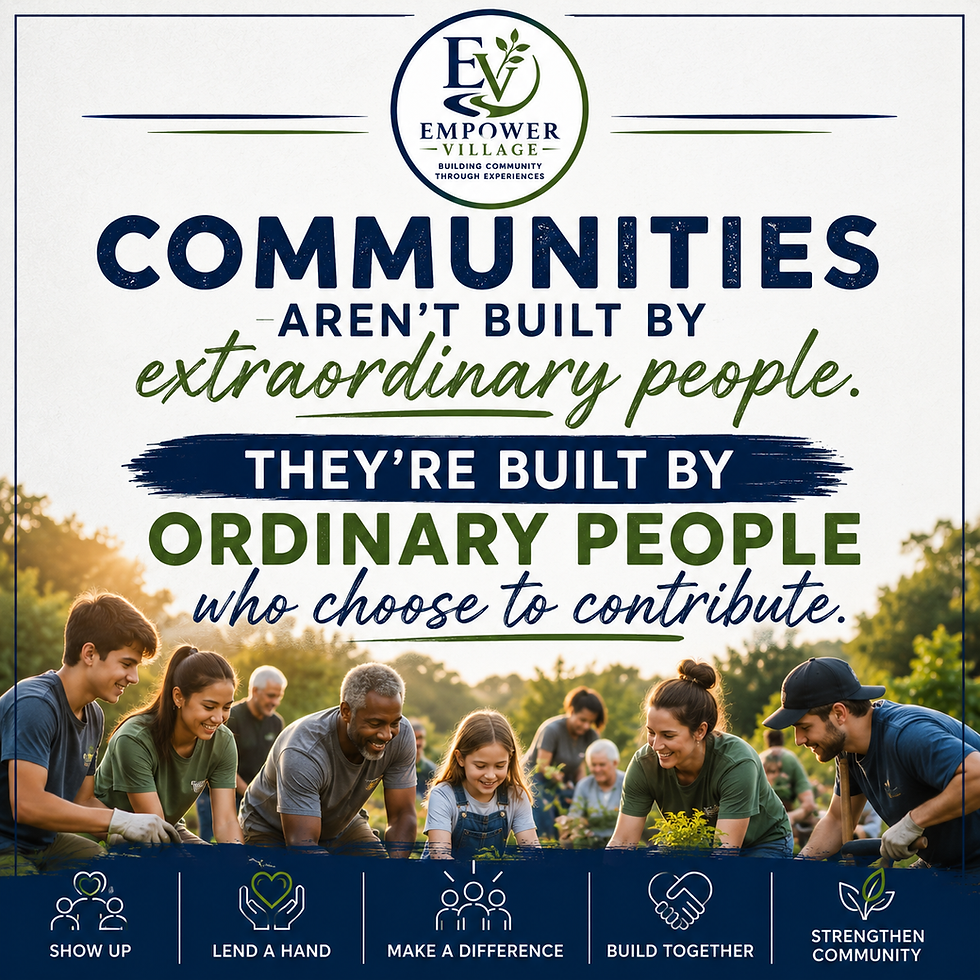
It might be a volunteer project.
A sports team.
A community class.
A neighborhood event.
A shared hobby.
The activity itself may seem ordinary, but it creates something far more valuable than the task being completed. It creates space for conversation. Trust begins to form. People start seeing one another as individuals instead of strangers.
That process is so common that we rarely notice it.
Until the opportunity isn't there.

The Opportunities We Never See
Imagine two people who live only a few miles apart.
One has spent thirty years teaching children.
The other has spent thirty years restoring antique furniture.
Both have knowledge that could enrich someone else's life.
Yet they never meet.
Not because they dislike one another.
Not because they disagree.
Simply because their paths never cross.
How many friendships never begin for that same reason?
How many mentors remain strangers?
How many ideas are never shared?
It's impossible to measure what never happened.
Yet those missed opportunities may shape our communities just as much as the relationships that do.
Community Is More Than a Place
When people talk about community, they often describe physical places—a town, a neighborhood, a school, or an organization.
But perhaps community is something less tangible.
Perhaps community is the collection of relationships that develop over time.
Every conversation adds another thread.
Every shared experience strengthens the fabric.
Every new friendship makes the whole community stronger.
Buildings matter.
Programs matter.
But relationships are what give those places life.

A Different Way to Think About Community
What if one of the greatest responsibilities of a community isn't simply providing services or hosting events?
What if it's creating opportunities for people whose lives might never otherwise intersect?
Opportunities to learn.
To build.
To volunteer.
To create.
To solve problems together.
Because when people work toward a common goal, something interesting happens.
The project eventually ends.
The relationship often doesn't.
Perhaps that's why the strongest communities aren't necessarily the ones with the most resources.
Perhaps they're the ones that create the greatest number of opportunities for strangers to become neighbors, neighbors to become friends, and friends to become the people who shape one another's lives.
The impact of those relationships may never appear in a report or a spreadsheet.
But their influence can last for generations.


Comments